Training a drone hover policy with RL#
This tutorial trains a quadrotor to hover at randomly placed target points using reinforcement learning (RL). It follows the standard three-file layout for an RL example in Genesis World: an environment that wraps the simulation as a gym-style task, a training script, and an evaluation script. The policy you obtain is small enough to run on a real Crazyflie.
The reward design follows Champion-level drone racing using deep reinforcement learning (Nature 2023). This is a minimal starting point, not a production pipeline: the reward terms are deliberately simple, and the default batch size does not push Genesis World’s parallel throughput.
The three files are the source of truth for the complete code:
examples/drone/hover_env.pydefines theHoverEnvtask.examples/drone/hover_train.pyconfigures PPO and runs training.examples/drone/hover_eval.pyloads a checkpoint and rolls out the policy.
The drone is actuated purely through its four propeller speeds. If you have not seen how RPM becomes thrust and attitude, read Drone entity first; this page assumes that mapping.
The task#
Each episode places a target point in front of the drone and rewards it for flying to that point and holding position. When the drone gets within at_target_threshold (0.1 m) of the target, a fresh target is resampled, so a single episode chains many reach-and-hold maneuvers. An episode lasts up to episode_length_s (15 s) and terminates early on a crash.
The task is defined by three things the environment must specify for any RL problem: an observation the policy sees, an action it produces, and a reward that scores the outcome.
The environment#
HoverEnv is a plain Python class, not a subclass of a gym base class. It exposes the methods an on-policy RL runner expects: reset(), step(actions), and get_observations(). All of its state lives in batched tensors of shape (n_envs, ...), so a single instance drives thousands of drones in parallel on the GPU.
Scene and drone#
The constructor builds a scene at a 100 Hz control rate and adds a ground plane, an optional target marker, and the Crazyflie drone:
self.dt = 0.01  # 100 Hz control loop
self.scene = gs.Scene(
    sim_options=gs.options.SimOptions(dt=self.dt, substeps=2),
    rigid_options=gs.options.RigidOptions(
        dt=self.dt,
        constraint_solver=gs.constraint_solver.Newton,
        enable_collision=True,
        enable_joint_limit=True,
    ),
    show_viewer=show_viewer,
)
self.scene.add_entity(gs.morphs.Plane())
self.drone = self.scene.add_entity(gs.morphs.Drone(file="urdf/drones/cf2x.urdf"))
self.scene.build(n_envs=num_envs)
build(n_envs=num_envs) is what allocates the batched simulation. During training this is 8192 environments; during evaluation it is 1.
Actions#
The policy outputs four numbers, one per propeller, clipped to [-1, 1]. The environment maps them to propeller RPM as a fraction of the hover RPM, the speed at which total thrust balances gravity:
self.actions = torch.clip(actions, -self.env_cfg["clip_actions"], self.env_cfg["clip_actions"])
# 14468 rpm is the hover point; actions scale each propeller to [0.2, 1.8] x hover
self.drone.set_propellers_rpm((1 + self.actions * 0.8) * 14468.429183500699)
self.scene.step()
Learning a fraction of hover RPM rather than an absolute RPM keeps the action range small and centered, which stabilizes early training. See set_propellers_rpm() for the RPM-to-force conversion.
Observations#
After each step the environment reads the drone’s state and assembles the observation. It is a length-17 vector per environment, with each block scaled into roughly [-1, 1] so no single quantity dominates the policy input:
self.obs_buf = torch.cat(
    [
        torch.clip(self.rel_pos * self.obs_scales["rel_pos"], -1, 1),  # target minus drone position (3,)
        self.base_quat,                                                # attitude, (w, x, y, z) (4,)
        torch.clip(self.base_lin_vel * self.obs_scales["lin_vel"], -1, 1),  # body-frame linear velocity (3,)
        torch.clip(self.base_ang_vel * self.obs_scales["ang_vel"], -1, 1),  # body-frame angular velocity (3,)
        self.last_actions,                                             # previous action (4,)
    ],
    axis=-1,
)  # shape (n_envs, 17)
Linear and angular velocities are expressed in the drone’s body frame (rotated by the inverse of the base quaternion), which makes the policy invariant to the drone’s heading. Position error rel_pos is target - drone_position in world coordinates. Attitude is a quaternion in (w, x, y, z) scalar-first order.
Rewards#
Five terms are summed each step, each scaled by dt and a weight from reward_cfg. The weights (positive rewards, negative penalties) live in hover_train.py:
target: rewards closing the distance to the target. It is potential-based: the reduction in squared distance from the previous step, so progress toward the target scores positively regardless of absolute distance.
smooth: penalizes large step-to-step changes in action, which suppresses jitter and narrows the sim-to-real gap.
yaw: rewards keeping heading near zero, using
exp(yaw_lambda * |yaw|).angular: penalizes body angular velocity, discouraging spin.
crash: a fixed penalty applied on any terminating condition below.
Termination and reset#
An environment terminates and resets when it times out or crashes. The crash conditions guard against unrecoverable states:
roll or pitch exceeds its threshold (180 degrees),
the drone drifts more than 3.0 m in x or y, or 2.0 m in z, from the target,
the drone descends below 0.1 m (into the ground).
reset_idx re-initializes only the terminated environments in place, so the batch never stalls waiting for the slowest episode. Resets re-sample a new target and zero the state buffers.
Training#
Training uses PPO from rsl-rl. Install the dependencies:
pip install --upgrade pip
pip install tensorboard "rsl-rl-lib>=5.0.0"
hover_train.py initializes Genesis World for the GPU in performance mode, constructs HoverEnv, wraps it in an OnPolicyRunner, and calls learn:
gs.init(backend=gs.gpu, precision="32", logging_level="warning", seed=args.seed, performance_mode=True)
env = HoverEnv(num_envs=args.num_envs, env_cfg=env_cfg, obs_cfg=obs_cfg,
               reward_cfg=reward_cfg, command_cfg=command_cfg, show_viewer=args.vis)
runner = OnPolicyRunner(env, train_cfg, log_dir, device=gs.device)
runner.learn(num_learning_iterations=args.max_iterations, init_at_random_ep_len=True)
performance_mode=True bakes the tensor shapes into the compiled kernels for faster stepping, at the cost of a slower first build. It is the right choice for a long training run and the wrong one for interactive iteration.
The actor and critic are both two-layer MLPs ([128, 128], tanh), configured in get_train_cfg. Start training with:
python hover_train.py -e drone-hovering -B 8192 --max_iterations 301
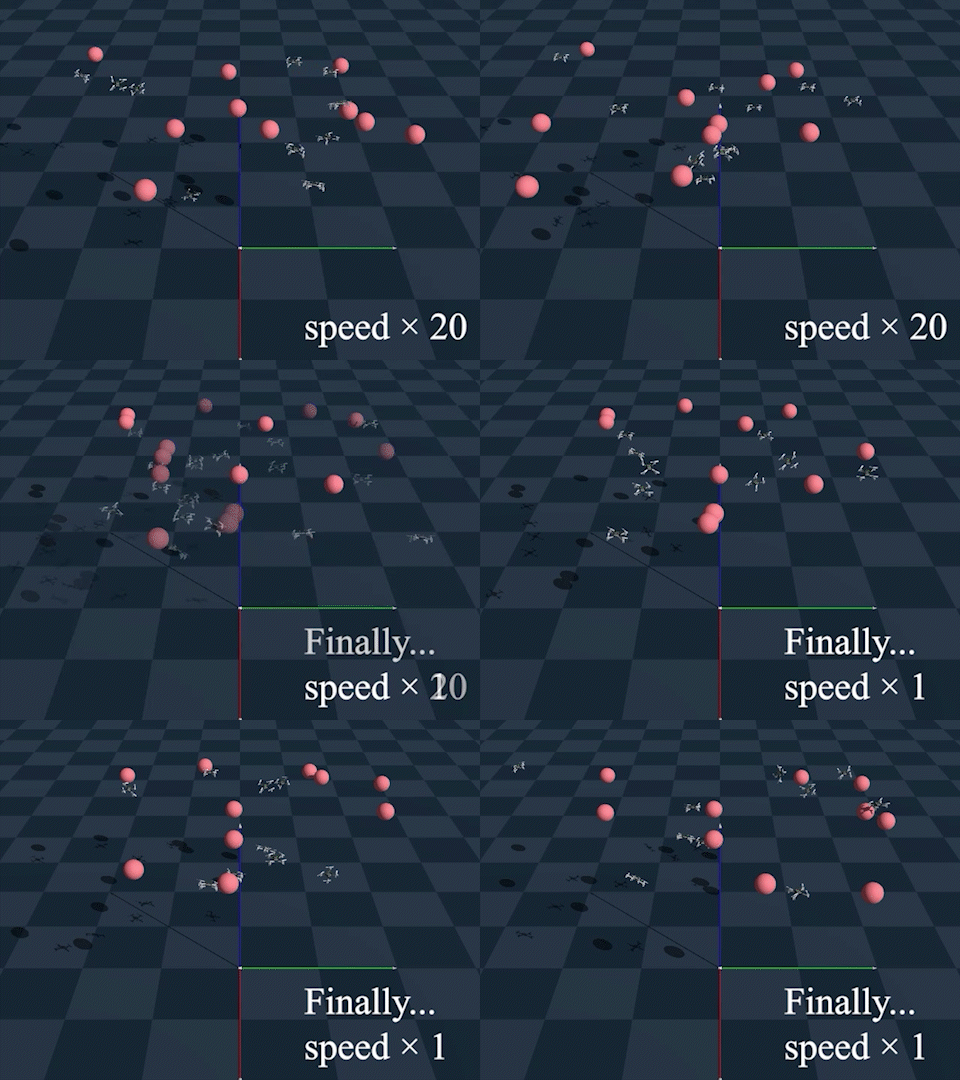
-e drone-hovering: experiment name; checkpoints and configs are written tologs/drone-hovering/.-B 8192: number of parallel environments.--max_iterations 301: number of PPO iterations.-v: optional, opens the viewer to watch training.
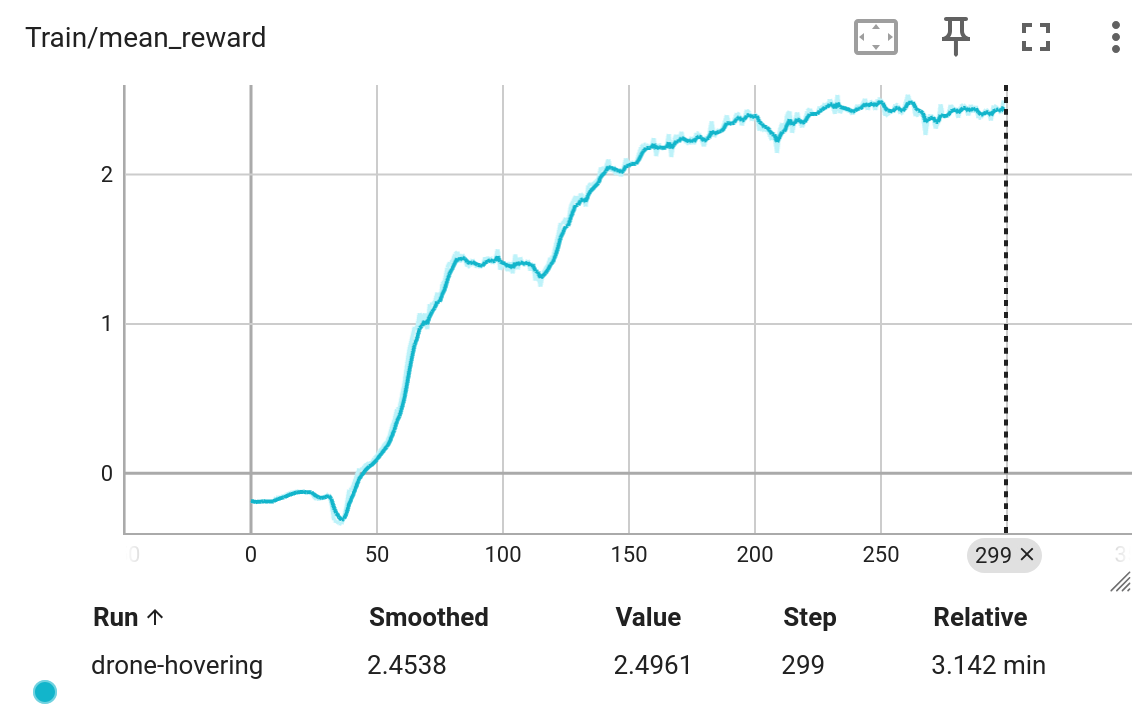
Monitor progress with TensorBoard:
tensorboard --logdir logs
With -v, the viewer shows a handful of environments training in parallel:
Evaluation#
hover_eval.py reloads the saved configs, rebuilds the environment with a single drone and the viewer open, and rolls out the trained policy deterministically:
python hover_eval.py -e drone-hovering --ckpt 300 --record
--ckpt 300: loadslogs/drone-hovering/model_300.pt.--record: attaches a camera and saves the rollout tovideo.mp4.
If evaluation is slow or unstable, drop --record to disable rendering.
See also#
Drone entity for how propeller RPM produces thrust, attitude, and yaw.
Training a locomotion policy with RL and Manipulation with two-stage training for the same environment/train/eval structure applied to other tasks.