Introduction#
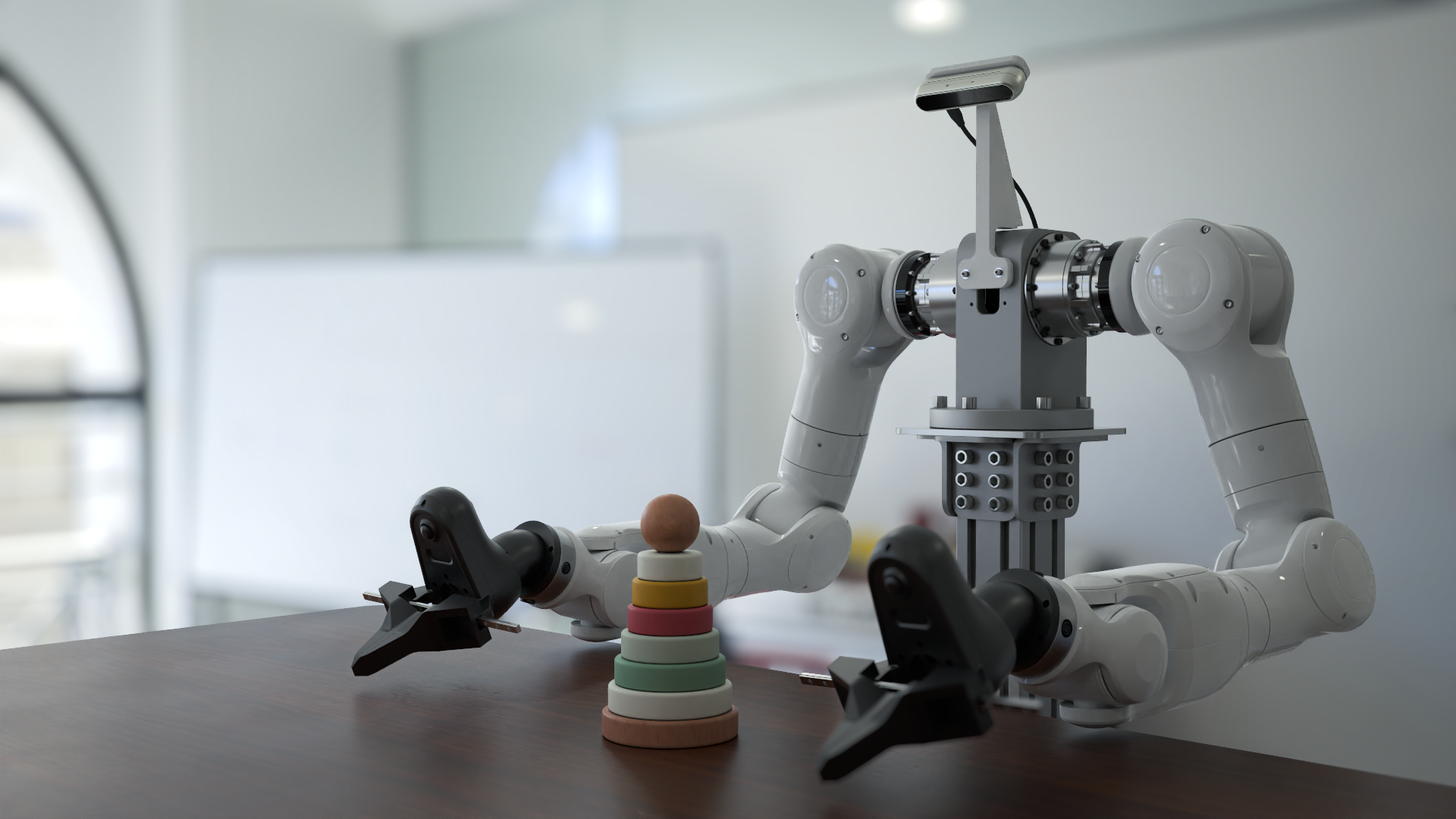
Genesis World is a simulation platform for physical AI development. It combines a unified multi-physics engine, a photorealistic renderer (Nyx), and a cross-platform compiler (Quadrants) behind a single Pythonic API. It scales from a laptop CPU to datacenter GPUs while staying readable and easy to embed in research code.
Genesis World began as an academic project in December 2024, under the name Genesis, and is now developed with support from Genesis AI. For the design rationale, see the blog post.
The stack#
Genesis World occupies four layers. Above it sits whatever you build: robotics environments, ML pipelines, or agentic simulation. Below it sits whatever compute backend you have.
Simulation interface: the user-facing API for asset parsing (URDF, MJCF, OBJ, GLB, USD, …), entity accessors, controllers, sensors, parallel and heterogeneous environments, and a built-in viewer.
Physics: a unified multi-physics engine integrating rigid, FEM, MPM, and particle (PBD/SPH) solvers, uipc, an explicit coupler, and SAP, all sharing one scene and one state.
Render: three rendering paths that plug in as camera sensors. Nyx is an in-house renderer built for robotics, Luisa is a DSL ray tracer, and Pyrender is a rasterizer.
Compiler: Quadrants lowers Python kernel code to CUDA, AMD ROCm, Apple Metal, Vulkan, x86, and ARM64. It carries the autodiff, GPU-graph, and fast-cache machinery.
Philosophy#
Genesis World is shaped by a few convictions about what a simulator for physical AI should be.
Transparent and Pythonic: the engine is open source and written in Python, so you can read it, debug it, and extend it, with no opaque binary between you and the physics.
Unified, not bolted together: rigid, FEM, MPM, and particle (PBD/SPH) solvers share one scene and one state with explicit coupling, rather than living in separate tools you have to stitch together.
Fast without cutting corners: simulation is parallelized across environments on the GPU, up to 10–80× faster than prior GPU-accelerated simulators such as Isaac Gym/Sim/Lab and MuJoCo MJX, without trading away accuracy. See the blog post for methodology.
Differentiable by design: autodiff and backpropagation run through the Quadrants compiler, with hand-derived gradients for the hardest kernels, so gradients flow through the physics.
Perception built in: physically accurate, differentiable tactile sensors sit alongside IMU, lidar, depth-camera, contact-force, surface-distance, and temperature-grid sensors, and all three renderers are exposed through the same camera-sensor interface, usable out of the box in parallel and heterogeneous environments.
Easy to start, easy to scale: a single
pip install, a small API, and the same code path from one environment on a laptop to thousands on a datacenter GPU.
Mission#
Simulation trains policies, generates data, and turns computation into capability. Yet researchers have long been held back by simulators that are hard to learn or closed off: intricate data-centric abstractions, heavy APIs, and physics they cannot inspect or adapt to what they observe in the real world.
Genesis World exists to change that. Our aim is a transparent, welcoming platform where researchers from physics simulation and robotics build a fast, physically and visually realistic virtual world together, and where the computer-graphics community’s advances in simulation and rendering reach robotics instead of staying out of reach. It is early, and a small team will not get everything right on a first release, so contributions of every kind are welcome. Open an issue or a pull request on GitHub; we would love to hear from you.