

Genesis World#





What is Genesis World?#
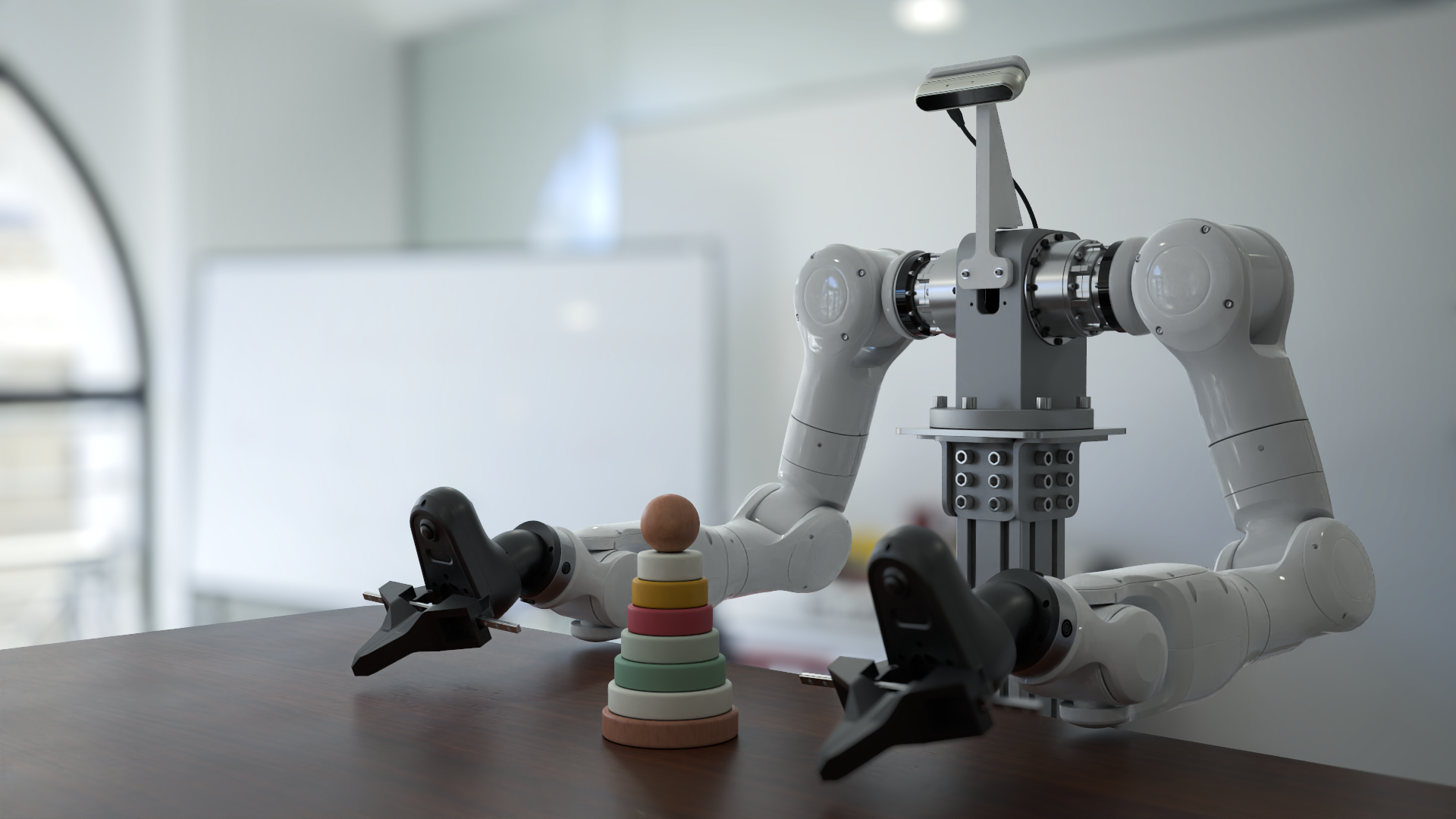
Genesis World is a simulation platform for physical AI development. It combines a unified multi-physics engine, a photo-realistic renderer (Nyx), and a cross-platform compiler (Quadrants) behind a Pythonic simulation interface. Genesis World is designed to scale from a single laptop kernel to datacenter-grade GPUs, while remaining easy to read, extend, and embed in research code.
It was previously named Genesis and started as an academic project in Dec 2024; its development is now officially supported by Genesis AI. For more technical details, see our blog post.
Genesis World occupies four layers. Above sits whatever you build (robotics environments, ML pipelines, agentic simulation); below sits whatever compute backend you have.
Simulation Interface — the user-facing API: asset parsing (URDF, MJCF, OBJ, GLB, USD, …), entity accessors, controllers, sensors, parallel and heterogeneous environments, and a built-in GUI.
Physics — a unified multi-physics engine integrating Rigid, FEM, MPM, Particle (PBD / SPH), uipc, an explicit coupler, and SAP, all sharing one scene and one state.
Render — three rendering paths plug in as camera sensors: Nyx (our in-house renderer designed for robotics), Luisa (DSL ray tracer), and Pyrender (rasterizer).
Compiler — Quadrants lowers Python kernel code to CUDA, AMD ROCm, Apple Metal, Vulkan, x86, and ARM64. It carries Genesis World’s autodiff, GPU graphs, and fastcache machinery.
Key Features#
Compared to prior simulation platforms, here we highlight several key features of Genesis World:
🐍 Pythonic and fully transparent. Genesis World is developed and fully open-source in Python, making code understanding and contribution way easier.
👶 Effortless installation and extremely simple and user-friendly API design.
🚀 Parallelized simulation with unprecedented speed: Genesis World is the world’s fastest physics engine, delivering simulation speeds up to 10~80x (yes, this is a bit sci-fi) faster than existing GPU-accelerated robotic simulators (Isaac Gym/Sim/Lab, Mujoco MJX, etc.), without any compromise on simulation accuracy and fidelity.
💥 A unified framework that supports various state-of-the-art physics solvers, modeling a vast range of materials and physical phenomena.
📸 Photo-realistic ray-tracing rendering via Nyx, with optimized performance for robotics applications.
📐 Differentiability: Genesis World is designed to be fully compatible with differentiable simulation, with autodiff and backpropagation infrastructure provided by Quadrants.
☝🏻 A comprehensive sensor system built into the simulation interface: physically-accurate and differentiable tactile sensors alongside IMU, lidar, depth camera, contact force, surface distance, and temperature grid sensors — all usable out of the box with parallel and heterogeneous environments.
Getting Started#
Quick Installation#
Genesis is available via PyPI:
pip install genesis-world
You also need to install PyTorch following the official instructions.
Documentation#
Please refer to our documentation site to for detailed installation steps, tutorials and API references.
Contributing to Genesis#
The goal of the Genesis project is to build a fully transparent, user-friendly ecosystem where contributors from both robotics and computer graphics can come together to collaboratively create a high-efficiency, realistic (both physically and visually) virtual world for robotics research and beyond.
We sincerely welcome any forms of contributions from the community to make the world a better place for robots. From pull requests for new features, bug reports, to even tiny suggestions that will make Genesis API more intuitive, all are wholeheartedly appreciated!
Support#
Please use Github Issues for bug reports and feature requests.
Please use GitHub Discussions for discussing ideas, and asking questions.
Citation#
If you used Genesis in your research, we would appreciate it if you could cite it. We are still working on a technical report, and before it’s public, you could consider citing:
@misc{Genesis,
  author = {Genesis Authors},
  title = {Genesis: A Generative and Universal Physics Engine for Robotics and Beyond},
  month = {December},
  year = {2024},
  url = {https://github.com/Genesis-Embodied-AI/Genesis}
}